
June 17, 2026
Resonac Corporation (President and CEO: Hidehito Takahashi; hereinafter “Resonac”) announces that the Japan Patent Office (hereinafter “JPO”) confirmed the validity of its Japanese patent on a liquid encapsulant (Patent No. 7687499) on March 11, 2026, following a third-party opposition regarding the patent’s validity. This patent represents a key technology for addressing reliability issues such as stress and crack generation caused by differences in thermal expansion between materials in 2.5D semiconductor packages for generative AI, where demand is expected to grow.
In recent years, with the rapid advancement of generative AI, demand has increased for AI semiconductors capable of high-speed processing of large volumes of data and improved power efficiency. To meet these needs, development of 2.5D semiconductor packaging technology, which enables high-density integration of multiple semiconductor chips, has progressed, and the market is expected to continue expanding.*1
In 2.5D semiconductor packages, semiconductor chips and interposer substrates*2 are connected to package substrates via small bump electrodes, leaving gaps between them. Liquid encapsulants fill these gaps and protect semiconductor packages from the effects of temperature, humidity, and mechanical stress.
As semiconductor packages continue to advance in performance, individual components such as semiconductor devices, interposer substrates, and printed circuit boards are becoming larger and more complex. As a result, in processes such as reflow soldering*3 for bump connections and reliability tests such as temperature cycling, stress caused by differences in the coefficients of thermal expansion and elastic modulus among materials has led to issues such as crack formation in substrates and encapsulant materials.
To address these challenges, Resonac developed a liquid encapsulant in which the coefficients of thermal expansion and elastic modulus are controlled within a specific range by optimizing the resin and additives used. The Company obtained a patent on this invention in May 2025. Subsequently, in November 2025, a third party filed an opposition; however, Resonac submitted arguments to the JPO regarding the novelty and inventive step of the invention. Following examination, the patentability of the invention was recognized, and the decision was made to maintain the patent.
To date, eight oppositions have been filed against Resonac’s patents related to liquid encapsulants for AI semiconductors. In all cases, patentability has been recognized and the patents have been maintained. By actively acquiring and utilizing intellectual property related to next-generation semiconductor material technologies, Resonac will secure its technological advantage and contribute to accelerating the development of advanced devices as a leading semiconductor materials company.
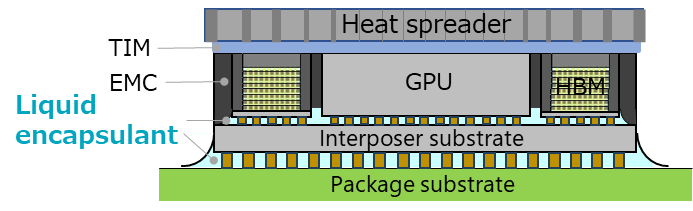
Cross-sectional view of leading-edge semiconductor package (an example)
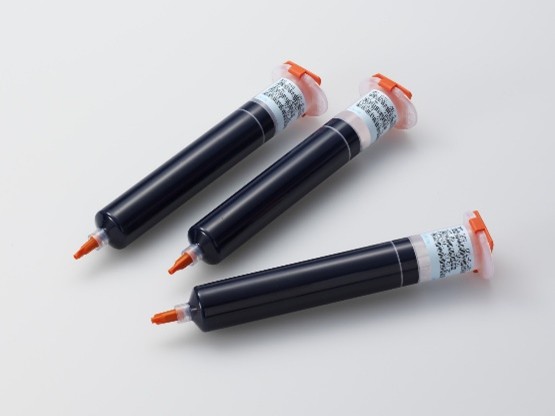
Liquid encapsulants