
September 16, 2026
TOKYO, Japan – September 16, 2026 – Resonac Corporation, a leading Japanese functional chemical manufacturer, today announced that the company has been conducting a joint demonstration program with Matlantis regarding a new feature, “Matlantis Case Studio,” for the universal atomistic-level simulator Matlantis™, which will soon be offered by Matlantis as an alpha version.
Matlantis Case Studio enables experimental chemists who have not previously specialized in computational science to handle simple simulations themselves on Matlantis. The new feature was developed and repeatedly tested leveraging feedback from Resonac’s research sites. Users can select a highly relevant case from existing computational cases and, through dialogue with AI, customize and execute the desired calculation without programming. Preferred Networks, Inc., which is responsible for the development of Matlantis, is also participating in this program.
Background
In recent years, the trend of “AI for Science,” which applies AI to the actual practice of scientific research itself, has begun to reach the field of materials development in earnest. In materials development, it has become clear that high-speed atomic and molecular simulations using AI can run alongside experiments to greatly improve the speed and accuracy of research and development. On the other hand, the use of computational science remains limited to specialized personnel, and the barrier remains high for experimental chemists to “test their own hypotheses through computation.” This joint demonstration program is an initiative to break through this situation and support, from the tool environment side, an “ambidextrous” state in which all researchers can freely use computational science tools. The goal is to make computational science one of the tools naturally incorporated into the daily research activities of experimental chemists, and Resonac’s research sites and Matlantis together took the first step toward this goal.
Overview of the Initiative: Co-Creation Between Resonac’s Research Sites and Matlantis
This joint demonstration program is a partnership program that Resonac’s Computational Information Science Research Center and Isesaki Plant, together with Matlantis and the Matlantis development team at Preferred Networks, have jointly conducted since October 2025. Through an agile process in which Resonac’s computational scientists and experimental chemists actually used functional prototypes and insights gained from that use were reflected in the features in short cycles, the teams repeatedly carried out feature development and demonstration. The direct voices of the research sites were the starting point for the design and improvement of this feature, and through this co-creation, the two companies have pursued features in a form that experimental chemists can use in their daily research and development.
Matlantis Case Studio: “Customize and Execute Calculations Through Dialogue with AI, Based on Existing Computational Cases”
Matlantis Case Studio, developed through this joint demonstration, was designed with an interface aimed at providing a user experience in which even researchers who have had few opportunities to engage with computational science can intuitively begin working from their first use. Specifically, it is built around the following three pillars.
1. Start calculations from a case of interest: By selecting materials and physical properties highly relevant to their own research and development themes from existing computational cases, users can smoothly begin the corresponding calculation.
2. From customization to execution through dialogue with AI: With an intuitively operable interface combining simple selections and inputs with AI, users can proceed consistently from setting calculation conditions through execution.
3. Support for displaying and reusing results: Calculation results are summarized and displayed in natural language, and execution histories can be saved and compared.
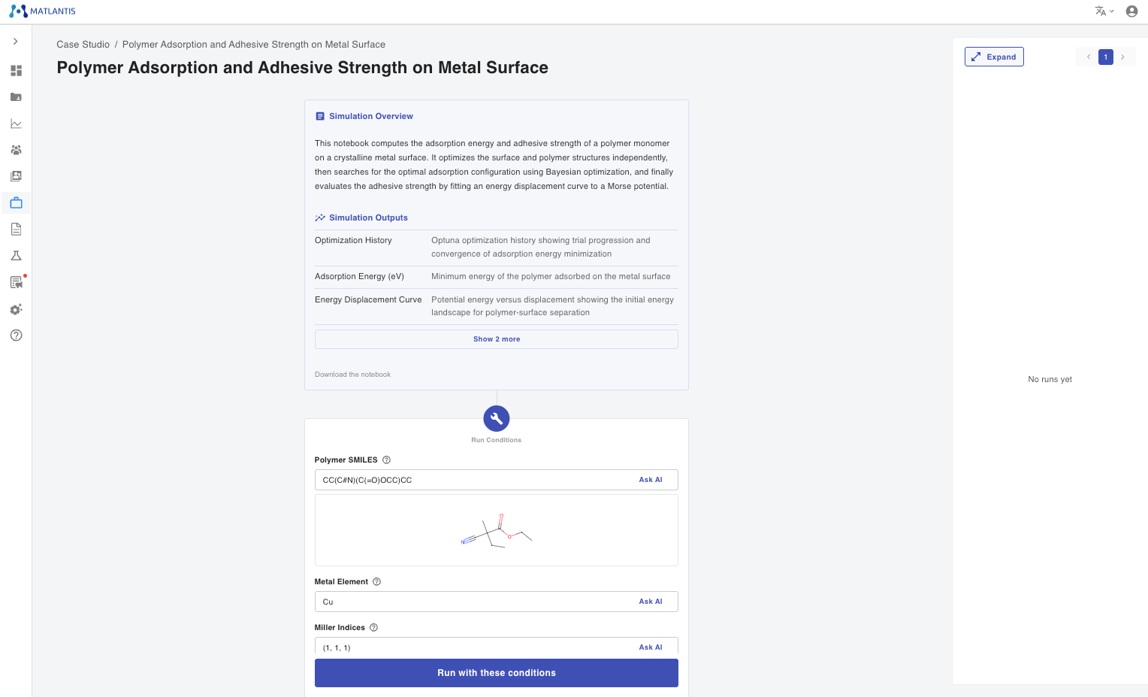
Matlantis Case Studio screen image
As the two companies collaborated and repeatedly improved the functional prototype through four demonstration experiments, they confirmed that researchers who do not specialize in computational science could complete calculations on their first use.
Voice of an Experimental Chemist
“Previously, when I wanted to use calculations to understand things such as the density of polymer materials under development or their adhesion to substrates, I needed the cooperation of computational scientists, and it took a certain amount of time to obtain results. This time, by selecting a case that matched my purpose from a list of existing computational cases at hand and executing the calculation through dialogue with AI, I was able to obtain estimated values that served as a guide for initial consideration. Not only can I advance idea validation and narrow down candidates myself before beginning experiments, but discussions with computational scientists based on the calculation results have also deepened, and connections to issues requiring more advanced calculations are becoming smoother. I feel that the way daily research itself is conducted will change as experimental chemists deepen their understanding of computation and work to solve problems using a common language and tools with computational scientists.”
Kazuki Kurahayashi, Isesaki Plant, Resonac
The Goal: Toward Research Organizations Where “Ambidexterity” in Experimentation and Computational Science Expands
The goal of this initiative is not simply to provide a new feature, but to establish through co-creation a “mechanism” that enables experimental chemists to continue incorporating computational science into their daily work. If experimental chemists can try calculations themselves at hand, small computational ideas that previously were not addressed through collaboration with computational scientists can also be tested within the flow of research, potentially leading to discoveries that were previously missed. At the same time, by making computational science a more familiar tool for experimental chemists, discussions with computational scientists are expected to deepen around more essential themes, accelerating overall collaboration between computation and experimentation within research organizations.
Comments Masato Fukushima, Executive Officer and CTO, Resonac Holdings Corporation
“To advance and accelerate materials development, it is becoming increasingly important to organically connect experimentation and computational science and use both mutually. However, because the use of computational science requires specialized knowledge and operation, barriers to its use have remained for many experimental chemists. In this joint demonstration, starting from researchers’ actual research processes and needs, we worked to realize an environment in which experimental chemists themselves can formulate and test hypotheses while making use of computation. With Matlantis Case Studio, we expect the cycle of quickly verifying ideas conceived by researchers through computation and reflecting the results in the next experimental plan to be incorporated more naturally into research activities. By developing computational science from a technology used only by some specialists into a research foundation that more researchers can use on a daily basis, we hope to expand the possibilities for new materials design and contribute to improving R&D productivity and accelerating innovation.”
Daisuke Okanohara, Representative Director, Matlantis Inc.
“Matlantis is at a stage of evolving from a ‘tool for computational specialists’ into a ‘platform that can be used by all researchers, including experimental chemists.’ This joint demonstration with Resonac is highly significant for Matlantis in that we were able to design and validate the direction of that evolution together with a user company actually working at the forefront of materials development. By incorporating Resonac’s on-site knowledge, we will evolve Matlantis into a form that can also be used naturally by experimental chemists. Starting with Matlantis Case Studio, we will bring the possibilities of AI for Science to more researchers and further broaden its use.”
Future Development
Matlantis Case Studio, developed through this joint demonstration, is scheduled to be offered by Matlantis in the near future as an alpha-version feature of Matlantis, primarily to user companies that cooperated in the demonstration. The two companies will continue this joint demonstration and expand their efforts toward verifying general applicability, expanding functionality, and creating mechanisms to organizationally accelerate collaboration between experimentation and computation.